


It Is a Skill to Be Loved (Yes, a Skill. With a Learning Curve.)


Somewhere along the way, we were taught that love is something you earn.
Be good enough.
Be chill enough.
Be impressive, funny, useful, self-aware-but-not-too-needy.
And if you do all of that correctly? Congratulations, you may now be tolerated… I mean loved.
But here’s the quieter truth most of us trip over as adults:
It is a skill to be loved.
Not to love, we’re usually great at that. To receive love? Whole different syllabus. And honestly, who reads a syllabus?
Why Being Loved Feels Harder Than Loving
Psychologically speaking, humans are wired for connection. But we’re also wired to avoid rejection. When those two instincts collide, we develop… coping strategies.
Some of the most common ones:
People-pleasing
Over-functioning
Humor-as-armor
Emotional independence (aka “I don’t need anyone”)
Being “the strong one”
None of these are character flaws. They’re survival skills.
Research on attachment styles shows that people who learned early on that love was inconsistent, conditional, or tied to performance often grow up highly capable, but deeply uncomfortable receiving care without doing something to deserve it.
In other words: You can be wildly competent and still freeze when someone loves you gently.
Here’s where the skill comes in.
Being loved requires you to:
let someone show up without earning it
accept care without minimizing it
stay present when someone sees you clearly
not immediately return the favor to “even the score”
(Yes, the urge to Venmo someone after they buy you dinner is emotional self-protection.)
Neuroscience backs this up: receiving kindness activates vulnerability centers in the brain. If your nervous system learned that vulnerability wasn’t safe, love can feel suspicious, even when it’s healthy.
Your body might be thinking:
“Why are you being nice? What’s the catch?”
Being loved often looks like this:
Someone compliments you→ You immediately insult yourself to restore balance
Someone offers help→ “No no no, I’ve got it” (you do not, in fact, have it)
Someone shows consistency→ “I’m bored” (you are actually just untriggered)
If love had a warning label, it would read:
May cause discomfort, emotional exposure, and an identity crisis if you’re used to earning your worth.
Love Is Not a Test You Pass
Here’s the reframe that matters:
Love isn’t something you prove yourself worthy of. It’s something you practice allowing.
And like any skill:
you can be bad at it at first
you can feel awkward learning it
you can mess it up and still improve
you don’t fail just because it feels hard
Learning to be loved often means unlearning:
self-abandonment
hyper-independence
the belief that needs = weakness
the idea that rest must be justified
That’s not laziness. That’s healing.
What Practicing “Being Loved” Can Look Like
Small, unglamorous reps count:
Say “thank you” instead of deflecting
Let someone help without explaining why you deserve it
Notice when you tense up around care, and get curious, not judgmental
Stay when it feels unfamiliar but safe
You’re not broken if receiving love feels unnatural. You’re just learning a skill no one taught you.
Final Thought (The Why Not Me? Part)
At some point, the question shifts from:
“Why is this so hard for me?”
to:
“Why not let this be easy?”
Why not let yourself be loved without performing? Why not trust that care doesn’t always come with conditions? Why not you?
Being loved isn’t a reward for becoming perfect. It’s part of becoming whole.
And yes, like any real skill, it gets better with practice.
The Honest Ending (My Part in This)
Here’s the part I don’t write from theory.
Loving others has always come easily to me. I know how to show up. I know how to see people. I know how to hold space, stay loyal, give grace, and love deeply, even when it costs me something.
Being loved back? That’s the harder skill.
For most of my life, love felt safer when I was the one giving it. Giving meant control. Giving meant I could stay useful, needed, appreciated. Receiving meant exposure. It meant trusting that someone could hold me without me shrinking, performing, or earning my place.
My healing has taught me something uncomfortable but freeing: The places we excel are often the places we learned to survive. And the places we struggle are often where we’re being invited to heal.
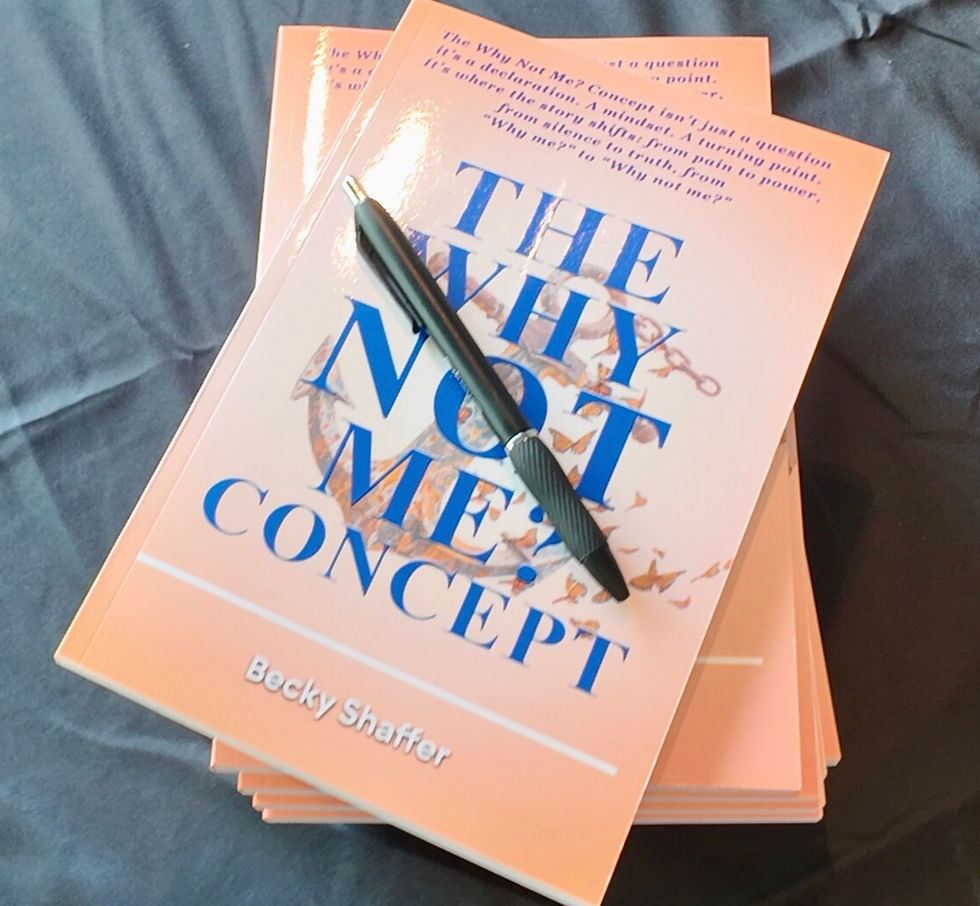
In The Why Not Me? Concept, I talk about reframing victimhood, not by pretending the pain didn’t shape us, but by recognizing when old survival patterns no longer get to lead. Loving others became a strength for me. Learning to receive love is becoming my work.
There are days I still flinch at softness. Days when consistency feels unfamiliar. Days when being chosen without effort makes me question myself instead of celebrating the moment.
And still, I stay.
Because healing isn’t about becoming someone who no longer struggles. It’s about becoming someone who no longer runs.
So if you’re like me, great at loving, not-so-great at receiving, this isn’t a flaw. It’s a starting point. A gentle invitation to practice something new. To let love be imperfect, slow, and occasionally uncomfortable.
The shift from Why me? to Why not me? isn’t about believing you’re suddenly healed or whole or fearless.
It’s about asking:
Why not let myself be loved the way I already love others? Why not believe I don’t have to prove my place? Why not stay when it feels unfamiliar, but safe? Love is still hard for me. But I’m learning.
And that, too, is part of the skill.
The Why Not Me? Moment
If loving others comes easily to you, but receiving love feels uncomfortable, pause here.
Ask yourself:
Where did I learn that giving made me safer than receiving?
What part of me still believes love has to be earned?
What would it look like to let care land without explaining, proving, or performing?
This is your Why Not Me? moment.
Not Why is love still hard for me? But Why not let myself learn this skill, too?
Why not allow love to be slow, steady, and imperfect? Why not trust that I don’t have to disappear to be chosen? Why not believe I can receive the same care I so freely give?
Healing doesn’t ask you to change who you are. It asks you to stop abandoning yourself in the process of loving others.
You don’t need to master this today. You just need to stay open enough to practice.
Why not me?
Becky Shaffer/Author "The Why Not Me? Concept"/Educator/Speaker


Comments